

Research Pen & Hardware FAQ
New to Research Pens? Start Here.
Welcome to the front lines of precision research. If you are new to using research pens, you’re in good company. Many researchers are moving away from traditional methods toward the accuracy of pen protocols.
Technical Note: These devices are professional-grade instruments. We operate under the assumption that researchers possess the institutional knowledge required to disassemble, load, and calibrate these units. To maintain our focus on hardware quality, we do not provide basic instructional manuals. We highly recommend testing your loading technique with a non-active solution first. Never test with your active compound; we are not responsible for product loss due to technique errors.
Shipping & Fulfillment
Shipping & Fulfillment
All orders are processed within 24hrs
Device Specifications & Calibration
- Dose Accuracy: All pens are calibrated at 0.01 mL per unit (equivalent to a standard insulin syringe).
- Capacity: We offer both 60-unit and 80-unit models. Select the capacity that matches your specific research protocol.
- Compatibility: Our pens are engineered exclusively for 3mL cartridges with 11mm long stoppers. Verify your cartridge specs before loading.
Where is the cartridge holder?
It’s there. To access it, you must PULL the pen apart to remove the cap. This will expose the holder, which you can then unscrew from the body. Avoid unscrewing the pen first, as this will leave the holder hidden inside the cap.
The "Corkscrew" Rule:
The plunger uses a precision corkscrew mechanism. When resetting the plunger or reloading, allow it to turn naturally under your finger as you press it back into the body. Never force it. Forcing the plunger can bend the internal drive and compromise accuracy.
Note on Resistance: The plunger will not advance without a cartridge installed. The system requires back-pressure to actuate; if it feels "loose" without a cartridge, that is normal.
Pro-Tips: Loading & Priming
Pro-Tips: Loading & Priming
To protect your compounds and ensure a sterile environment, we recommend the Vent Air Displacement Method:
- Create a Relief Valve: Use a 1mL syringe barrel (plunger removed) as a vent. Insert it into the self-sealing top of your cartridge.
- Transfer: Insert your compound syringe next to the vent and inject slowly. You will hear the air escape, preventing a pressure buildup that could blow out the bottom stopper.
- Priming: Once loaded and assembled, dial a small dose (approx. 5 units), hold the pen needle-up, and tap to move air to the top. Press the button until a steady drop appears.
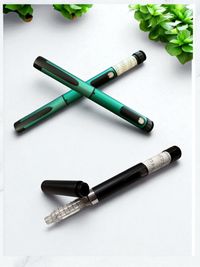
Understanding Hardware Generations (V1, V2, V3)
- V1 Models: Solid, sealed design. Ideal for researchers who prefer a standard, rugged storage environment. Available in 60-unit and 80-unit slimline.
- V2 Models: Feature the "Injecthru" port. This retractable ring system hides the needle during administration—perfect for researchers managing needle apprehension. (60-unit only).
- V3 Models: The slimline version of the V2, combining the "Injecthru" feature with a more compact profile.
- "Universal fit" refers to the thread, not the performance. Your needle choice dictates the fluid dynamics of your research.
- Gauge & Viscosity: While these pens were designed for low-viscosity fluids (like insulin), many research compounds are thicker. A higher gauge (32G/33G) has a finer bore and creates more resistance.
- Our Recommendation: For consistent flow and reduced back-pressure, we suggest a 29G or 30G needle (at least 5mm length).
- Equalization: After the dose is complete, hold the needle in place for 10–15 seconds. This allows the internal pressure to equalize and prevents post-dose dripping.
If you experience a firm injection or a drop at the tip after withdrawal, check the following:
- Temperature: Cold solutions are more viscous. Allow your research materials to reach room temperature naturally.
- Clarity: Ensure your compound is fully reconstituted. Microscopic particles can clog fine-gauge needles.
- Needle Quality: Use high-quality, thin-wall needles to improve flow efficiency.
Need Technical Support?
Reach out to our team at [email protected]. We are here to ensure your hardware performs to the highest standard.